
Now Reading: How to Layer Korean Serums Like a Pro in 2026
- 01
How to Layer Korean Serums Like a Pro in 2026


If you’ve ever wondered how Korean women achieve that coveted glass skin glow, the secret often lies in how they layer multiple serums. Understanding how to layer Korean serums correctly can transform your routine from chaotic to strategic, helping each product work at its full potential without causing irritation, pilling, or wasted product.
This guide breaks down the exact order, timing, and technique you need to master Korean serum layering in 2026, whether you’re a beginner or looking to refine your existing routine.
Why Koreans Layer Multiple Serums
Korean skincare philosophy centers on targeted treatment rather than one-size-fits-all solutions. Instead of relying on a single multitasking product, the approach involves using several lightweight serums, each formulated to address a specific concern like hydration, brightening, anti-aging, or soothing.
This allows you to customize your routine based on your skin’s changing needs throughout the year or even day to day. In winter, you might add more hydrating layers. During summer, you can scale back to lighter formulas. The Korean 7 skin method, which involves patting in multiple layers of hydrating toner or essence, exemplifies this philosophy of building moisture in thin, absorbable layers.
Layering also maximizes ingredient efficacy. By applying actives in a specific order, you ensure each ingredient penetrates properly and doesn’t interfere with others. If you’re exploring which products to start with, check out the best Korean serums on Amazon for beginner-friendly options.
The Golden Rule: Thin to Thick Consistency
The foundation of proper skincare layering routine is simple: apply products from thinnest to thickest consistency. Lightweight, watery serums should go on first, followed by milkier essences, then thicker serums, and finally creams and oils.
This order ensures each layer absorbs properly. If you apply a thick cream first, lighter serums won’t be able to penetrate through that barrier. Think of it like building layers of paint, you need a smooth, thin base before adding heavier coats.
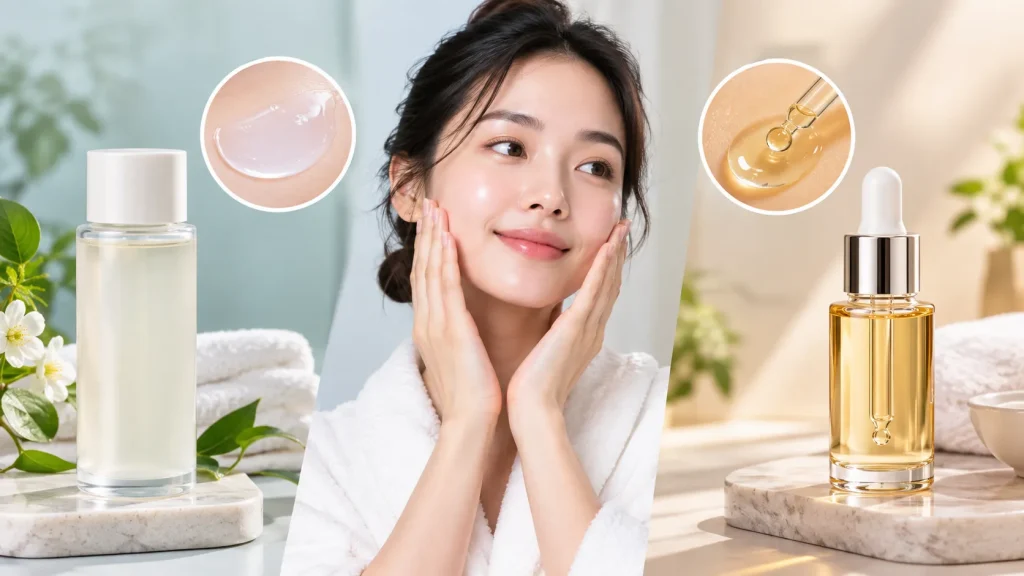
When in doubt, do the texture test. Pour a drop of each serum on the back of your hand. The one that feels most watery and absorbs fastest goes first. The one that sits on your skin longest goes last.
Step-by-Step Serum Layering Order
Here’s the correct order to apply Korean serums after cleansing and toning:
- Watery essence or first treatment essence: These prep the skin for better absorption. Pat in gently with your palms.
- Hydrating serum: Typically hyaluronic acid based, these provide moisture and plump the skin.
- Treatment serums: Apply actives like vitamin C (morning), niacinamide, or peptides. If using multiple treatment serums, apply the thinnest one first.
- Targeted serums: Spot treatments for dark spots, redness, or specific concerns go here.
- Serum or ampoule with thicker texture: Richer, more concentrated formulas come near the end of the serum step.
- Eye cream: Apply before moisturizer to ensure it reaches delicate under-eye skin.
- Moisturizer: Seal everything in with your cream or gel moisturizer.
- Face oil or sleeping mask (evening only): The final occlusive layer locks in all previous steps.
For a complete understanding of the broader Korean skincare sequence, explore the glass skin Korean skincare routine that puts serum layering in context.
How Long to Wait Between Each Layer
One of the most common questions is: how long to wait between serum layers? The answer depends on the product’s texture and your skin’s absorption speed.
As a general rule, wait 30 to 60 seconds between layers. This gives each serum time to penetrate without fully drying down. You want the skin to feel slightly damp, not completely dry or soaking wet.
For thinner, watery serums, 30 seconds is usually enough. For thicker, more emollient serums, wait closer to a minute. If you notice pilling (when products ball up on your skin), you’re likely not waiting long enough or applying too much product at once.
Active ingredients like vitamin C or retinol may benefit from a slightly longer wait time (one to two minutes) to ensure they’re fully absorbed before layering the next product. However, there’s no need to wait five or ten minutes, that’s overkill and won’t improve results.
Avoiding Ingredient Conflicts and Pilling
Not all serums play well together. Certain ingredient combinations can cause irritation, reduce effectiveness, or lead to frustrating pilling.
Common ingredient conflicts to avoid:
- Vitamin C and niacinamide: While newer research suggests they’re fine together, some formulations can cause flushing or reduce efficacy. If your skin is sensitive, use vitamin C in the morning and niacinamide at night.
- Retinol and vitamin C: Both are strong actives. Use vitamin C in the morning and retinol at night to avoid irritation.
- Retinol and AHA/BHA exfoliants: Combining these can over-exfoliate and damage your skin barrier. Alternate nights or use exfoliants in the morning, retinol at night.
- Multiple strong actives: Don’t layer tretinoin, glycolic acid, and high-strength vitamin C all at once. Build up tolerance slowly.
To prevent pilling:
- Use less product (a pea-sized amount per serum layer is plenty).
- Wait longer between layers to allow proper absorption.
- Avoid silicone-heavy serums under water-based products.
- Pat products in gently rather than rubbing vigorously.
Understanding what order to apply Korean serums means respecting both texture and ingredient science.
Morning vs Evening Serum Layering Strategies
Your serum layering order should differ between morning and evening to match your skin’s needs and environmental factors.
Morning routine focus: Protection, brightening, and lightweight hydration.
- Vitamin C serum for antioxidant protection and brightening
- Lightweight hydrating serum with hyaluronic acid
- Niacinamide for pore refining and oil control
- Finish with SPF (non-negotiable)
Keep morning layers light so makeup applies smoothly and your skin doesn’t feel greasy by midday.
Evening routine focus: Repair, treatment, and deep nourishment.
- Hydrating essence or toner (multiple layers if doing the 7 skin method)
- Treatment serums with actives like retinol, peptides, or AHA
- Richer, more emollient serums
- Heavier moisturizer or sleeping mask
Nighttime is when your skin repairs itself, so this is the best time for potent actives and richer textures. You can layer more products in the evening since you don’t need to worry about makeup application or sun exposure.
How Many Serums Is Too Many
Can you use multiple Korean serums together? Absolutely. But how many serums to use depends on your skin’s tolerance, your concerns, and the time you have.
For beginners, start with one to two serums: a hydrating serum and one treatment serum targeting your main concern (brightening, anti-aging, or acne). As your skin builds tolerance and you understand what works, you can add more layers.
Experienced users often layer three to five serums, especially in evening routines. Some Korean skincare enthusiasts use even more, but that level requires careful attention to ingredients and skin response.
Signs you’re using too many serums:
- Your skin feels congested or breaks out more than usual
- Products pill or don’t absorb properly
- Your skin looks greasy or feels heavy
- You experience increased sensitivity or irritation
- Your routine takes so long you start skipping it
Quality trumps quantity. Three well-chosen, compatible serums will always outperform seven random products slapped on in the wrong order.
Adapting Layering for Different Skin Types
Korean serum layering for beginners should account for your specific skin type to avoid overloading or under-nourishing your skin.
Oily or acne-prone skin:
- Stick to lightweight, water-based serums
- Focus on hydration (dehydrated skin overproduces oil)
- Use niacinamide and salicylic acid for oil control
- Limit to two to three serum layers to avoid heaviness
Dry or dehydrated skin:
- Layer multiple hydrating serums (hyaluronic acid, glycerin, beta-glucan)
- Use the 7 skin method with hydrating toner
- Add a few drops of facial oil as the final step
- You can comfortably use four to five serum layers
Combination skin:
- Use lighter serums on your T-zone, richer serums on dry areas
- Consider split routines (different products for different zones)
- Focus on balance with hydrating plus sebum-controlling ingredients
Sensitive or reactive skin:
- Start with minimal layers (one to two serums max)
- Choose fragrance-free, gentle formulations
- Introduce new products one at a time, waiting two weeks between additions
- Focus on soothing ingredients like centella, panthenol, and madecassoside
Explore more K-Beauty tips and product recommendations tailored to various skin concerns.
Putting It All Together: Your Serum Layering Blueprint
Now that you understand the principles, here’s a practical example of a complete serum layering routine:
Morning (3 serums):
- Hydrating toner (pat in with hands)
- Vitamin C serum (wait 60 seconds)
- Hyaluronic acid serum (wait 30 seconds)
- Eye cream
- Lightweight moisturizer
- Sunscreen SPF 50+
Evening (4 serums):
- Hydrating toner (layer 2 to 3 times using the 7 skin method)
- Niacinamide serum (wait 60 seconds)
- Peptide serum (wait 30 seconds)
- Retinol serum (wait 90 seconds)
- Rich moisturizer or night cream
- Facial oil or sleeping mask
Remember, this is just a template. Adjust based on your skin’s needs, the season, and how your skin responds. Some days you might only need two serums; other days you might want five. Listen to your skin.
Serum application technique matters as much as order. Always use gentle patting motions rather than rubbing. Press products into your skin with your palms to encourage absorption and boost circulation. Never tug or pull, especially around delicate areas like the eyes.
For more curated product selections and in-depth reviews, visit our K-Beauty category featuring trending favorites and hidden gems.
Final Thoughts on Mastering Korean Serum Layering
Learning how to layer Korean serums is less about following rigid rules and more about understanding the logic behind the technique. Once you grasp the thin-to-thick principle, respect ingredient interactions, and pay attention to your skin’s feedback, you can build a customized routine that delivers real results.
Start simple, add layers gradually, and give your skin time to adjust. The Korean approach to skincare is patient and intentional, not rushed or aggressive. With consistent practice, you’ll develop an intuitive sense of what your skin needs and how to layer products for maximum benefit.
Whether you’re working with two serums or seven, the goal remains the same: healthy, glowing skin that looks and feels its best in 2026 and beyond.