
Now Reading: South Korea Selects a Texas Power Project for Its US Investment Plan
- 01
South Korea Selects a Texas Power Project for Its US Investment Plan


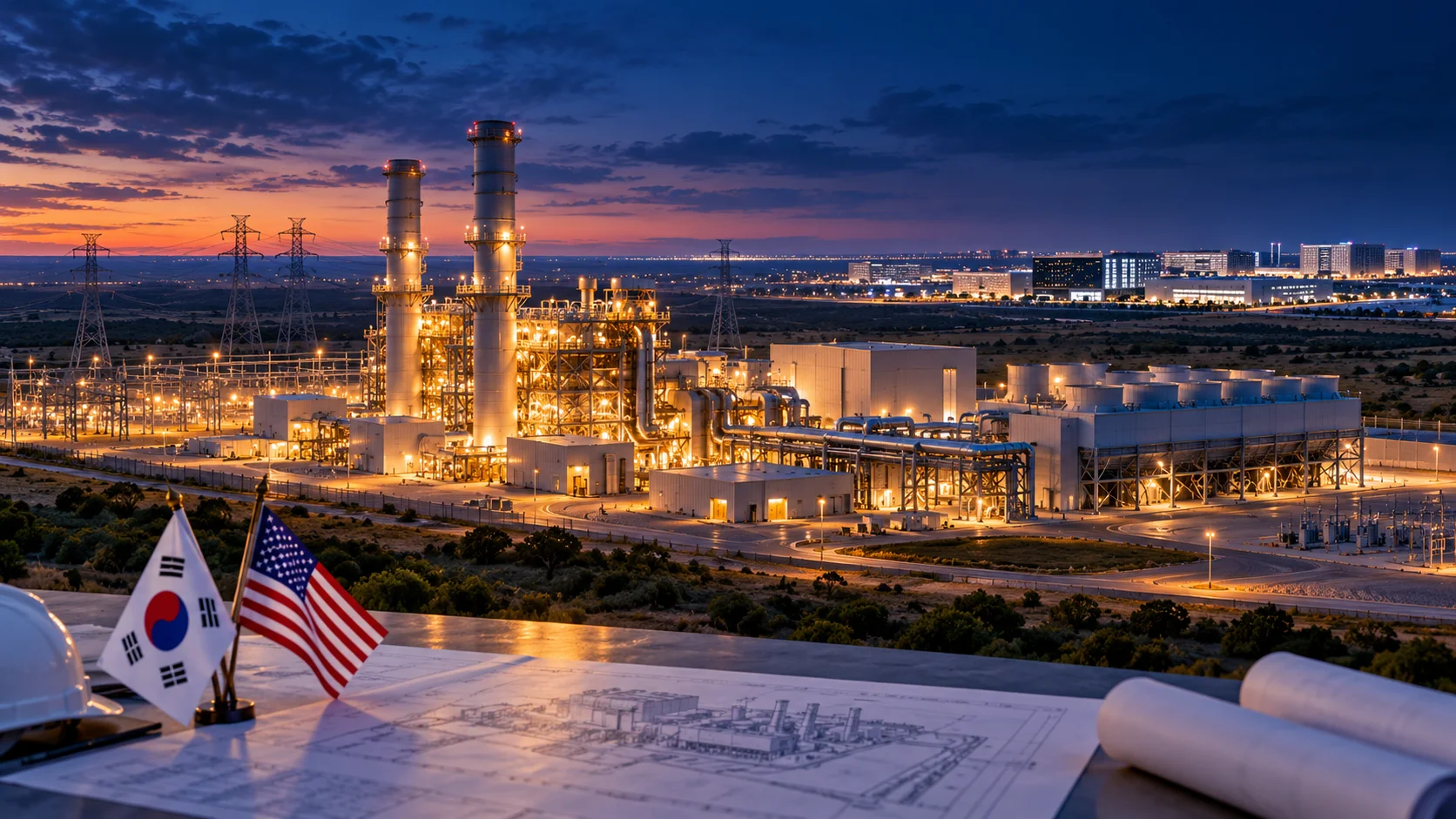
South Korea has identified a proposed power plant in Texas as the first project under its $350 billion investment commitment to the United States. The decision gives a specific shape to a deal previously discussed mainly in terms of its overall value. It also connects two priorities for the countries: Korean investment in American infrastructure and the electricity needed to support US technology growth.
The selection is a meaningful step, but it does not mean construction has started. The investment still requires review by a US government investment committee and further negotiations. Those remaining steps matter when considering the project’s eventual cost, ownership and timeline.
What is the proposed Texas project
The selected proposal is a gas-fired power plant in Encinal, Texas. Reuters reported that the planned facility would have a capacity of 6.3 gigawatts and cost more than $20 billion, citing other media reports for those project figures. Its intended customers include AI data centers and semiconductor factories. The final specifications may become clearer as the governments complete their discussions.
Data centers run computers continuously, while chip production requires a dependable electricity supply. A plant designed to serve those facilities would therefore support the infrastructure behind expanding technology operations. That explains why an energy project can be a central part of a wider industrial investment plan.
The location also makes this a direct Korea–US business story. Korean capital would be directed toward a proposed American power facility, while companies operating in the United States could gain another source of electricity. The exact commercial benefits will depend on the terms agreed and whether the project is built as proposed.
How does it fit into the wider investment deal
The Texas plant forms part of a $350 billion South Korean investment commitment associated with a trade agreement between Seoul and Washington. A White House fact sheet divides that commitment into $150 billion for shipbuilding and $200 billion for additional strategic investments. Energy, semiconductors and artificial intelligence are among the sectors named in the bilateral plan. The same fact sheet describes a 15% tariff framework for certain South Korean goods.
Selecting the first possible investment does not release the full pledged amount at once. Each project has to be assessed on its own terms. Reuters reported that South Korea’s industry minister briefed lawmakers on the Texas selection and said the US investment committee must review the plans. Further talks with US Commerce Secretary Howard Lutnick were also required.
For readers tracking this announcement, the distinction is simple: Seoul has chosen a project to pursue, while key details still need agreement. It should not yet be described as a completed power plant or a finalized transfer of the entire investment commitment.
Why is commercial viability under scrutiny
A power station valued at more than $20 billion needs to earn returns over many years. Some South Korean lawmakers have questioned whether the proposed investments would be commercially sound and whether Korea would take on too much financial risk. Reuters reported that the government considered the Texas project viable under a 20-year profit-return structure. That remains an assessment rather than a guaranteed return.
The pace of funding matters as well. The White House fact sheet says South Korea would not be required to provide more than $20 billion in any calendar year under the strategic investment commitments. It also allows discussion of timing if the commitments could unsettle the Korean foreign exchange market. These provisions help explain why negotiations involve financing schedules as well as headline investment figures.
Lawmakers will want to see how costs, ownership and revenues are divided. For an investment this large, clear terms would allow both countries to judge whether the promised economic benefits justify the risks.
What other US projects are being discussed
Texas is not the only energy investment on the table. According to Reuters, South Korea is considering a stake in US nuclear technology company Westinghouse. The two countries have also discussed nuclear reactor construction in the United States. Participation in a delayed Alaska liquefied natural gas project remained undecided at the time of the report.
Those proposals are at different stages and should be followed separately. The Texas facility is the first project Seoul selected under the investment plan; the Westinghouse, reactor and Alaska ideas are possibilities still subject to their own negotiations. Taken together, they show how energy infrastructure has become a major focus of the Korea–US economic relationship.
What happens next
The next milestones are the US committee review, negotiations between officials and a final announcement setting out the Texas project’s terms. Details about financing, ownership and a construction schedule would make it easier to judge when the proposed plant might become a functioning facility.
For now, South Korea’s selection of the Encinal project is a concrete first step. Whether it becomes a successful investment will depend on a commercially workable agreement and the project’s eventual delivery. Its progress will offer an early measure of how the broader Korea–US investment commitment translates into real infrastructure.